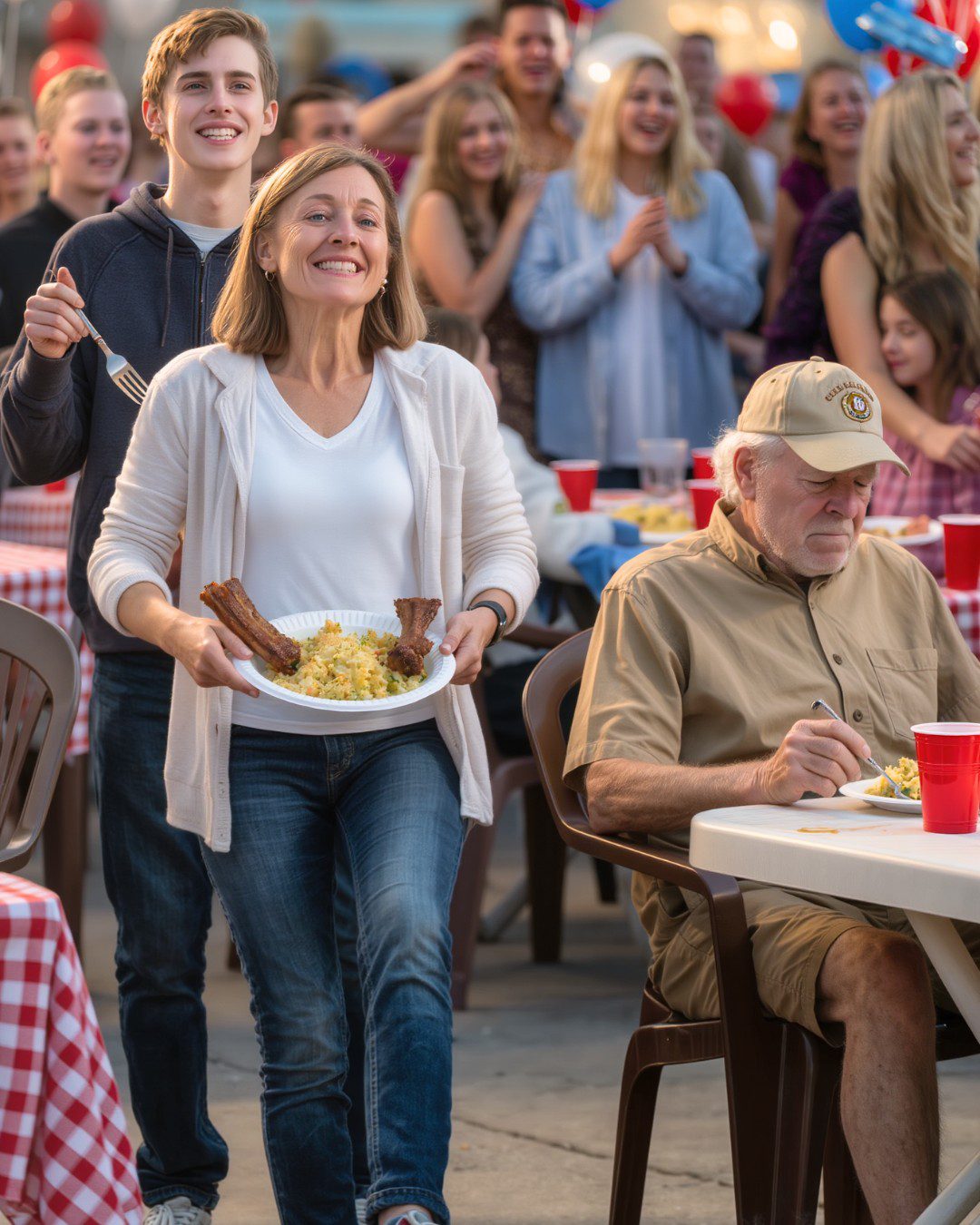
The bulbs were the cheap kind, the ones that give off more heat than light, and they buzzed faintly over the Kalen family backyard. It smelled like charcoal and lighter fluid and overcooked hot dogs. Folding tables were lined up end to end, covered in plastic tablecloths that stuck to your forearms when you leaned on them. Someone had set a Bluetooth speaker on the deck railing, and it was doing its best to compete with the shrieks of children and the clatter of plastic cups.

My niece’s graduation party.
I was balancing a paper plate piled with food—potato salad, ribs, coleslaw that looked suspiciously glossy—trying not to spill anything as I made my way back to my usual place on the edge of everything. My son, Elias, walked beside me, hands buried deep in the pocket of his hoodie despite the late spring heat. His shoulders rounded in that familiar way, like he was trying to fold himself small enough to disappear.
Up near the grill, my father, Gerald, held court like he always did. Khaki shorts, white socks yanked up to his calves, veterans cap snug on his head as if it were welded there. His belly pressed against the edge of the table as he raised a red plastic cup high in the air.
“To how far the Kalen name has come!” he boomed.
Everyone around him cheered. They always did when he said things like that. “The Kalen name.” As if we were some old-money dynasty instead of a middle-class Pennsylvania family with three used cars and a collective addiction to potato salad.
I shifted my plate to my other hand and forced my face into the role I always played at gatherings like this: the Smiler. The Nodding One. The Black Sheep Who Doesn’t Cause Trouble.
“Mom, we don’t have to stay long,” Elias murmured, barely moving his lips.
“I know,” I said softly. “Just a bit. For your cousin.”
My niece, Emily, fluttered past us in her Stanford sweatshirt, tan legs, perfect hair, a cluster of friends trailing behind her like a comet’s tail. There was a banner with her photo printed across it strung along the fence—CONGRATS EMILY!—and a gift table sagging under the weight of envelopes and neatly wrapped boxes.
I was genuinely proud of her. I really was. She’d worked hard. She deserved the full ride scholarship and the applause and the banner with her face on it.
But as I watched my son duck his head and angle toward the shadowed edge of the yard, a thought dug its claws into me and wouldn’t let go.
He’s just as smart. Maybe smarter.
Elias had gotten into three great universities. Three. He’d done it while working part-time at the grocery store and helping me care for my mother during chemo. No private tutors, no paid SAT prep courses. Just his brain, his stubbornness, and a pile of worn-out notebooks filled with ideas.
He had grit. He had heart.
He had me.
I watched my father slosh beer dangerously close to the rim of his cup as he went on about “the opportunities we never had when we were kids” and how “this is what good decisions look like.” Around him, my siblings—Catherine in her carefully pressed sundress, Joel with his new watch flashing every time he lifted his drink—nodded like the choir responding to their preacher.
My niece’s other grandparents were there too, beaming, dabbing tears from their eyes, hugging Emily every few minutes as if to make sure she was real. I saw my sister’s college fund envelope, the one our parents had given her, tucked under a stack of cards waiting to be opened.
I swallowed. The words rose in my throat before I could second-guess them.
I stepped closer to my father, still clutching my plate like a shield.
“Dad,” I said, trying to sound casual, light, non-confrontational. “Since we’re talking about all this—college and the future and everything—does Elias get a piece of the college fund too?”
I could feel Elias beside me, still and silent. On the surface, it was just a question. A practical one. Our parents had always talked about that college fund as something for “the grandchildren.” Plural. Not just one.
My father didn’t even look at me.
He didn’t raise his head, didn’t pause, didn’t take even a heartbeat to consider.
He stabbed at his paper plate with a plastic fork and said, in a bored mutter that sliced clean through the noise of laughter and music around us:
“Why waste it on him? He’s from a broken home.”
Just like that.
Matter-of-fact. Like a weather report.
The word “waste” hit me first. Then “broken.” Then the way his mouth twisted around the word “home” like it tasted bad.
Something inside me tore.
Not because I hadn’t heard worse. I had.
Not because Elias hadn’t been excluded before. He had.
But it was the casualness. The ease. As if this judgment of my son’s entire worth were obvious. Established. A family fact.
I stood there, frozen, while the fairy lights hummed overhead and the smoke from the grill curled into the early evening sky. Some distant cousin laughed too loudly at a joke. A toddler toppled over on the grass and started to cry. The Bluetooth speaker crackled and jumped to the next song.
Elias went very still beside me, fork hovering over the mound of potato salad on his plate. For a heartbeat, I thought he might say something. But he just lowered his eyes, the line of his mouth flattening, and took an exaggeratedly normal bite.
I felt my throat closing. My vision dimmed at the edges.
I wanted to smash my father’s plastic cup out of his hand. To flip the folding table and watch the paper plates and cutlery scatter everywhere like white shrapnel. I wanted to grab that veterans cap off his head and throw it across the yard and shout, “Don’t you dare talk about him like that. You don’t know him. You’ve never tried to.”
Instead, I did what I have done my entire life in this family when the hurt comes like a wave.
I smiled.
I didn’t trust my voice. I didn’t trust the burn behind my eyes. So I swallowed everything—rage, shame, disbelief—and folded it into that tight, practiced smile.
“Excuse me,” I murmured, though no one was looking at me anymore.
I turned away, took Elias’s free hand, and gently tugged.
“We’re going,” I whispered.
